What Human OS Is
Human OS is a standalone symbolic-computational model.
It turns messy human situations into structured state maps, tracking pressure movement, loop formation, and likely next-state direction before visible response fully stabilizes.
It can operate as its own model layer, and it can also support AI systems before response generation.
Why Human OS Is Different
Map before response
Human OS builds the state map before output generation.
Surface is not the whole event
The visible sentence becomes an entry point into inner state movement.
Pressure becomes traceable
Human OS follows pressure as it repeats, redirects, or grows heavier.
Next-state reading stays bounded
The model predicts likely movement without claiming certainty.
Input and Output
Input
- Messy human situations
- Neutral signals that feel heavier than they should
- Repeated loops
- Defensive surfaces
- Pressure-loaded interactions
Output
- Situation Map
- Pressure Movement
- Active Loop
- Likely Next State
- Uncertainty Boundary
- Readable Output
How the Model Runs
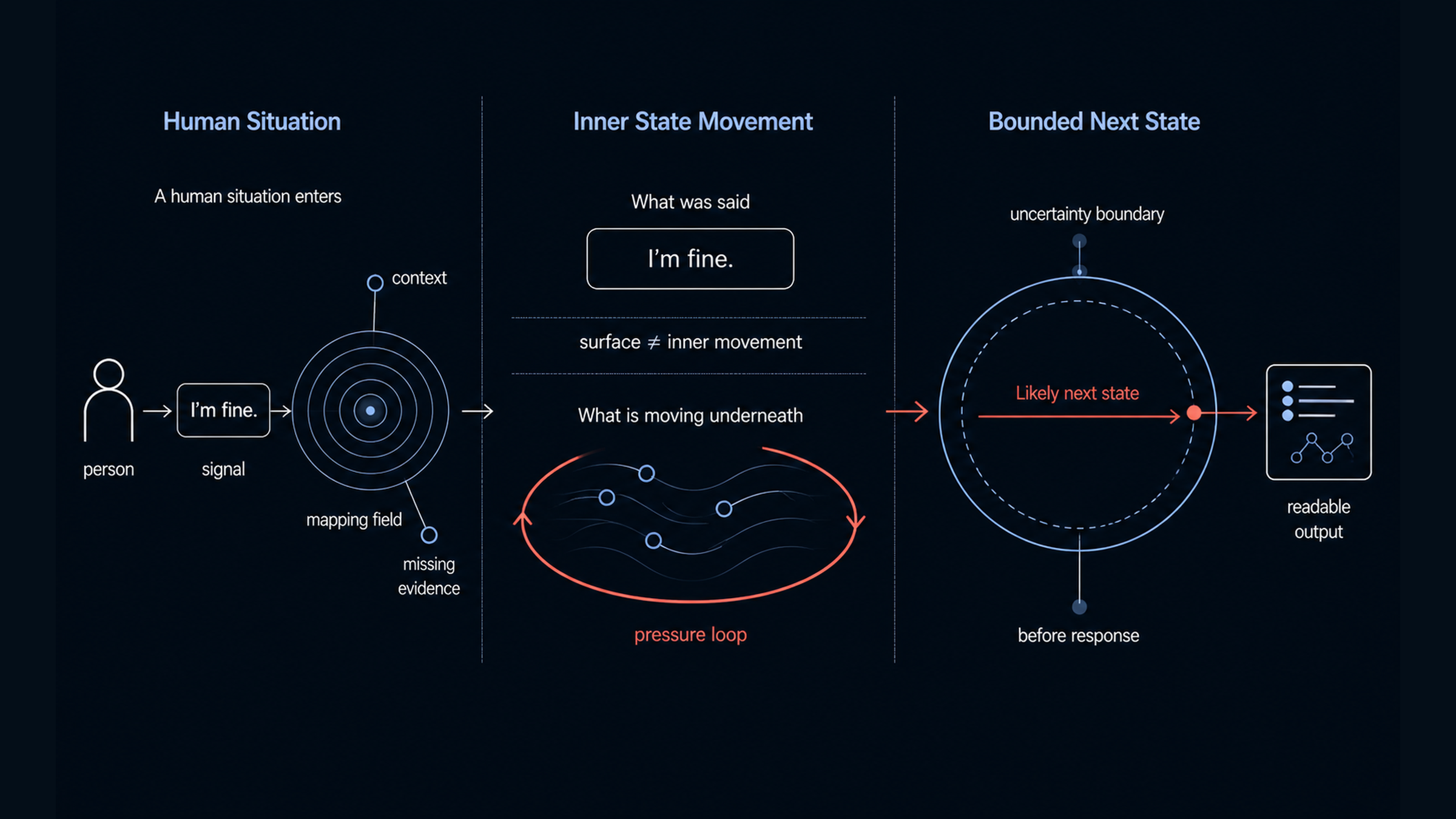
Human OS maps the situation before response generation, separates surface signal from inner movement, and produces a bounded next-state reading.
Examples
A neutral signal feels heavier than it looks.
Human OS maps the hidden pressure and predicts the likely next state.
The same conflict keeps repeating.
Human OS maps the loop instead of only describing the surface disagreement.
A surface answer misses what is moving.
Human OS traces the deeper movement before response.
Access the Model
Supporting Resources
Human OS provides bounded model outputs and does not claim whole-person simulation or clinical authority.